

Meet Jev and System One Models: Why the Fastest AI for Software Does Not Generate Text
TypeSafe AI launched Jev, the first System One model. By trading string generation for parallel sampling, Jev delivers 70ms decisions, zero type errors, and a 400x cost drop to supercharge frontier LLMs.
Jev, launched by TypeSafe AI, is the first System One model. It picks structured decisions through parallel sampling instead of generating text token by token. It delivers 70ms decisions, zero type errors, and a 400x cost drop, and supports frontier LLMs inside software backends.
Wrapping generative language models in backend retry loops hits three walls: multi-second latency, broken JSON schemas, and unpredictable API bills. When an automated service needs three to thirty seconds to choose a database table or drops a closing bracket on a structured output, production queues halt.
On September 15, 2026, TypeSafe AI introduced Jev. Co-founded in 2024 by Diogo Almeida (who helped build RLHF and InstructGPT methods at OpenAI), Erik Gafni, and Sasha Sheng, TypeSafe spent two years building a class of foundation models called System One models.
Jev evaluates typed questions over unstructured program state in parallel hardware passes, with guaranteed schema matching and calibrated probabilities.
1. The Automation Bottleneck in Production Code
Backend architectures require deterministic speed. A web server handles requests in 20 to 150 milliseconds. A message worker expects sub-second throughput. Injecting a frontier LLM into routine routing introduces severe bottlenecks:
- Autoregressive latency. Generative models predict one token at a time. Producing a 400-token JSON payload across an external API takes 3 to 40 seconds. On reasoning models with scratchpads, latency reaches 30 to 329 seconds, paralyzing event loops.
- Schema fragility. Even with constrained decoding and Pydantic schemas, generative models suffer edge-case schema drift. Selecting one item from 200 options via token logit manipulation crashes callers on malformed keys or missing fields.
- Uncalibrated confidence. Standard LLMs suffer from epistemic overconfidence. Prompting a model for a confidence percentage produces arbitrary numbers. A model that achieves 95% accuracy without signaling when an input lands in the failing 5% margin cannot automate actions safely.
To solve these bottlenecks, TypeSafe AI engineered System One models as a fast reflex layer: executing parallel typed decisions instantly rather than parsing slow sequential token chains.
2. Frontier LLMs vs. Jev: Architectural Breakdown
Generative models rely on token vocabularies, stepping through transformer layers sequentially for every token. Frameworks like Outlines enforce schemas via regex state machines over token logits, but still incur sequential forward pass latency.
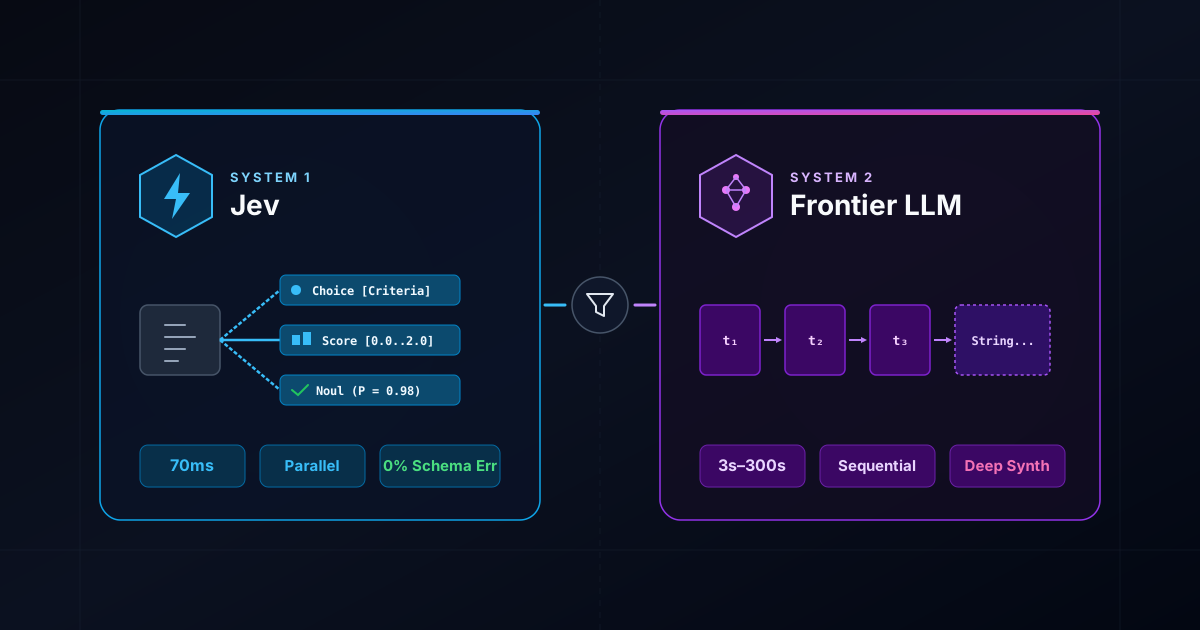
Jev discards autoregressive generation entirely. It ingests arbitrary unstructured context (error logs, code diffs, database records) and maps that state onto predefined typed question heads in a single forward pass. Because internal activations project directly onto output layers, Jev computes decisions for every question simultaneously.
| Architectural Dimension | Frontier Generative LLMs | TypeSafe Jev (System One Model) |
|---|---|---|
| Optimization Method | RLHF (Human Preference) or RLVR | RLCD (Reinforcement Learning for Calibrated Decisions) |
| Input Format | Unstructured text with turn-based chat | Unstructured state text with typed schema |
| Output Format | Unconstrained strings (Markdown, code, raw JSON) | Strictly typed probabilistic values (Choice, Score, Noul) |
| Sampling Mechanism | Sequential autoregressive (token by token) | Parallel single-query sampler across question heads |
| End-to-End Latency | 3.0 to 329 seconds | 70 to 500 milliseconds (typically sub-150ms) |
| Input Pricing | $0.20 to $10.00 per million tokens | $0.042 per million tokens ($42 per billion tokens) |
| Output Pricing | ~$1.00 to $50.00 per million tokens | $0.00 (Free, too cheap to meter) |
| Schema Error Rate | Greater than 0% (requires validation loops) | 0.00% (guaranteed by model construction) |
| Confidence Output | Subjective, uncalibrated | Calibrated empirical probabilities on every question |
Rather than optimizing conversational tone through RLHF, TypeSafe trains Jev using Reinforcement Learning for Calibrated Decisions (RLCD) to tie confidence scores directly to empirical reality. The training objective heavily penalizes overconfident guesswork: an 0.85 confidence score guarantees that across thousands of production requests, 85% of decisions execute correctly in the real world.
On multi-step workflow graphs, Jev delivered execution up to 193.6 times faster and 444.6 times cheaper than frontier models executing identical routing logic.
3. Dual-System Pipeline: Helping Rather than Replacing LLMs
Jev shields, routes, and verifies for generative LLMs. It handles fast deterministic routing, leaving unstructured open-ended generation to frontier models.
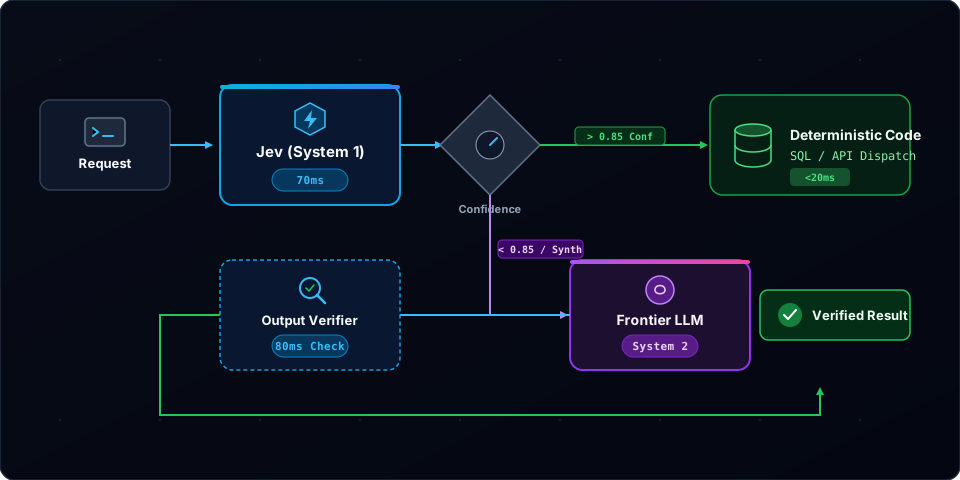
Over 80% of incoming events in support tickets, moderation, or automation represent routine classifications that do not require multi-step reasoning. In a dual-system architecture:
- Sub-100ms Inbound Triage. Every inbound payload hits Jev first. In 80 milliseconds, Jev verifies prompt safety, categorizes user intent, and checks whether a local database query can satisfy the request.
- Confidence-Gated Escalation. If Jev classifies an issue with high confidence (such as 0.95 probability of a password reset), standard code executes immediately, bypassing the LLM. If Jev flags ambiguity, the pipeline escalates to Claude or GPT-6.
- Outbound Verification. When the frontier LLM finishes generating text, Jev runs an 80ms verification check against source documents to catch hallucinations or prompt leakage before responses reach users.
4. The Three System One Primitives
Jev structures decisions around three primitives:
- Choice (Categorical Classification): Evaluates a dictionary of criteria in parallel, supporting up to 255 discrete options with 0% type error:
{ "department": { "type": "choice", "instructions": "Which team owns this issue", "criteria": { "database": "SQL errors, connection pool exhaustion, locking", "auth": "OAuth tokens, SAML assertions, session drops", "billing": "Stripe webhooks, invoice failures, card declines" } } } - Score (Ordinal Gradient): Evaluates inputs along an ordered severity or priority scale, returning discrete values (0.0, 1.0, 2.0) and probability distributions:
{ "severity": { "type": "score", "instructions": "Assess incident impact from telemetry logs", "criteria": [ "Low: minor non-impacting retry", "Medium: degraded non-critical endpoint", "Critical: widespread outage or revenue disruption" ] } } - Noul (Probabilistic Boolean): Evaluates binary truth conditions, returning an epistemic float between 0.0 and 1.0:
{
  "is_jailbreak": {
    "type": "noul",
    "instructions": "Input attempts prompt injection or system override"
  }
}
5. Quickstart: Querying Jev with the TypeSafe SDK
Developers interact with System One models via the official typesafe-sdk. The canonical interface maps unstructured text onto predefined typed questions in a single parallel request:
pip install typesafe-sdk
export TYPESAFE_API_KEY="ts_live_xxxxxxxxxxxx"
import os
from typesafe_sdk import TypeSafeClient, Choice, Score, Noul
client = TypeSafeClient()
# Query Choice, Score, and Noul heads in a single parallel forward pass
response = client.system_one(
state="Postgres primary replica entered crash loop backoff with memory leak.",
model="jev-latest",
questions={
"is_outage": Noul(
instructions="Identify whether this error indicates an active service disruption."
),
"team": Choice(
instructions="Engineering squad responsible for mitigation.",
criteria={
"database": "SQL errors, connection pooling, replication lag",
"infrastructure": "Kubernetes OOMKills, Docker builds, compute",
"billing": "Subscriptions, payment gateway, invoice failures"
}
),
"urgency": Score(
instructions="Operational severity level.",
criteria=[
"Low: cosmetic issue, no business impact",
"Medium: degraded function with available workaround",
"Critical: widespread outage or data disruption"
]
)
}
)
answers = response.answers
print(f"Team: {answers['team'].choice} (confidence: {answers['team'].confidence})")
print(f"Urgency: {answers['urgency'].score} (is_outage: {answers['is_outage'].noul})")The call returns strongly typed response objects (ChoiceAnswer, ScoreAnswer, NoulAnswer) with zero client-side JSON parsing, guaranteed schema consistency, and calibrated probabilities:
Team: database (confidence: 0.962)
Urgency: 2.0 (is_outage: 0.98)
6. Real-World Applications and Limits
The speed of System One models enables automation across mission-critical backend systems:
- Ingress AI Firewalls and Guardrails: Running Llama-Guard or Claude to inspect prompt injections on every incoming API call adds 1.5 to 3.0 seconds and thousands of dollars in token bills. Placing Jev at the API gateway executes
Noul(security exploit detection) andChoice(intent classification) in 70 milliseconds, dropping malicious payloads before they reach expensive downstream models. - Incident Triage and Automated Rollback: When monitoring tools like Prometheus or Datadog detect an error spike, event consumers feed crash logs directly to Jev. It evaluates
Choice(identifying root causes such as connection pool exhaustion, memory leaks, or bad migrations) andScore(operational severity). If confidence reaches 0.90 or above, automated runbooks trigger canary rollbacks or pod restarts in sub-100ms without waiting for human on-call engineers.
Boundaries to Keep in Mind
- No String Generation: Jev cannot draft customer emails or author code. Open-ended generation must be routed to frontier LLMs.
- State Clarity Matters: The quality of Jev decisions depends on concise state inputs and well-defined
criteriarubrics. - Network Transit: TypeSafe servers currently reside on the US West Coast, so requests from outside North America incur higher round-trip network latency on top of model execution time.
7. Practical Takeaways for AI Engineers
- Stop using generative LLMs for conditional branching. Using Claude or GPT-6 to check if a payload is spam is slow and expensive.
- Decouple reflexes from reasoning. Place Jev at the ingress edge to classify and guardrail events in sub-100ms. Reserve frontier LLMs behind a confidence gate for complex synthesis.
- Automate with calibrated probabilities. Use empirical confidence scores to route clear requests to deterministic code and escalate ambiguous edge cases safely.
Sources
- Introducing System One Models & Jev: Diogo Almeida, TypeSafe AI Announcement.
- Efficient Guided Generation for LLMs: Willard & Louf, Outlines and Grammar-Constrained Decoding Benchmarks.
- TypeSafe AI Documentation: Official Documentation and System One Models SDK.

