DeepSeek Harness Review: Hands-On, and How It Compares to Claude Code, Codex and Antigravity
A hands-on DeepSeek Harness review: we built a plugin in the desktop app, then compare the open-source agent runtime with Claude Code, Codex and Antigravity.
Short answer: DeepSeek Harness (dsh) is an open-source agent runtime under the MIT license, released by DeepSeek on August 13, 2026. Almost everything in it is a plugin, including the agent loop, so you can swap parts one by one (VentureBeat, The New Stack). In an independent 30-task test with one model, dsh solved 20 tasks and Claude Code 19, while dsh used about 7 times fewer tokens (Composio). It is still a developer preview. Choose it to take an agent apart, and choose Claude Code, Codex or Antigravity when work is due this week.
What is DeepSeek Harness?
A harness is the software around a model. It decides how the model calls tools, edits files, stores sessions and stays on a long task. The idea behind DeepSeek's release is the formula "Agent = Model + Harness" (DataCamp). Version 0.1 shipped together with the V4-Pro-0813 model.
It is built on Cordis, a plugin framework, runs on Node.js, and comes as a local web UI, a headless command, a Python SDK and a desktop app, which we tested below. The repo warns that there will be compatibility-breaking changes. For why harness design matters, see how agentic engineering replaces vibe coding.
What makes it different?
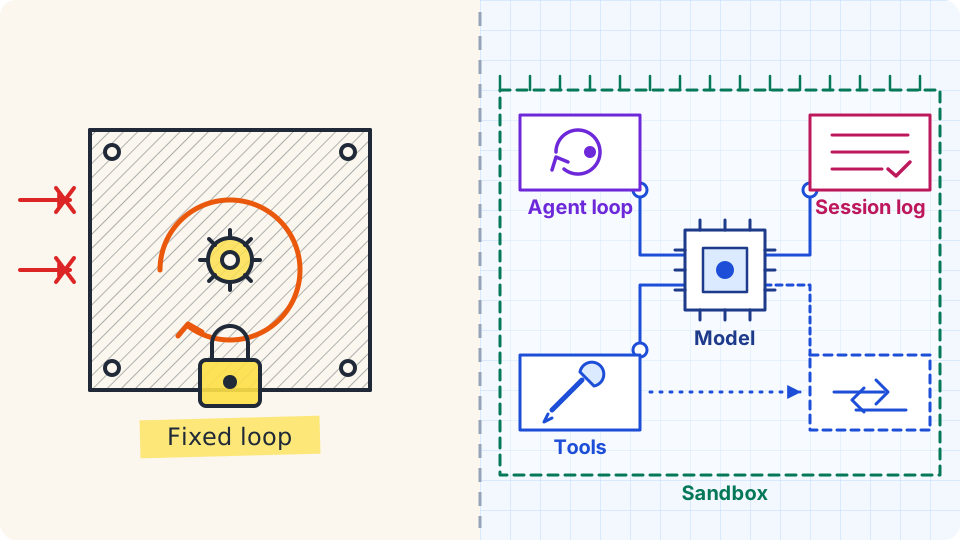
- A replaceable agent loop. Model adapter, tool registry, session log and agent loop are all plugins, with no privileged core to patch. Composio counts around 30 lifecycle hooks in Claude Code, plus skills, subagents, MCP and plugins, all attached to one fixed loop.
- No lock-in to one model. DataCamp lists DeepSeek, Anthropic, OpenAI, Bedrock, Vertex, Azure and local endpoints. So dsh can run Claude models, and Claude Code runs only Claude.
- It can drive other agents. It speaks the Agent Client Protocol, can launch Claude Code or Codex as child processes, and reads
CLAUDE.mdandAGENTS.md. - Traceable sessions. Each session is an append-only, replayable event log, and, per Composio, the sandbox backend defaults to read-only (the desktop app defaults to Workspace Write).
What does it look like in practice?
The desktop app opens on a composer with a workspace picker, a mode switch, an access mode and a model picker, plus a sidebar for Plugins, Automation tasks and workspaces. The model here was DeepSeek-V4.1-Flash at High effort.
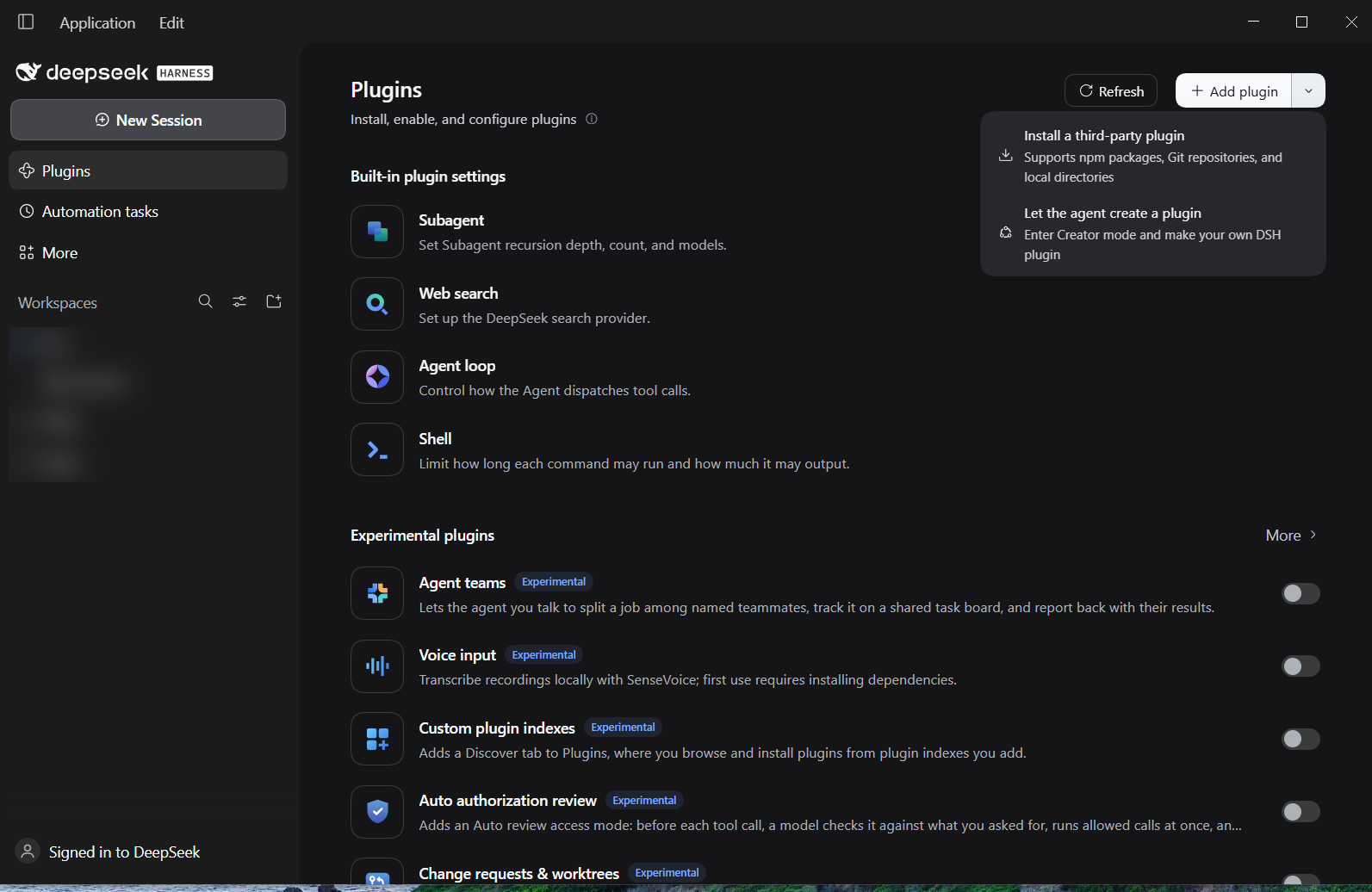
The Plugins page shows the "everything is a plugin" claim
Four built-in plugins have settings: Subagent, Web search, Agent loop and Shell. Below them sit experimental plugins that are off by default, such as Agent teams, Voice input, Custom plugin indexes, Auto authorization review and Change requests & worktrees.
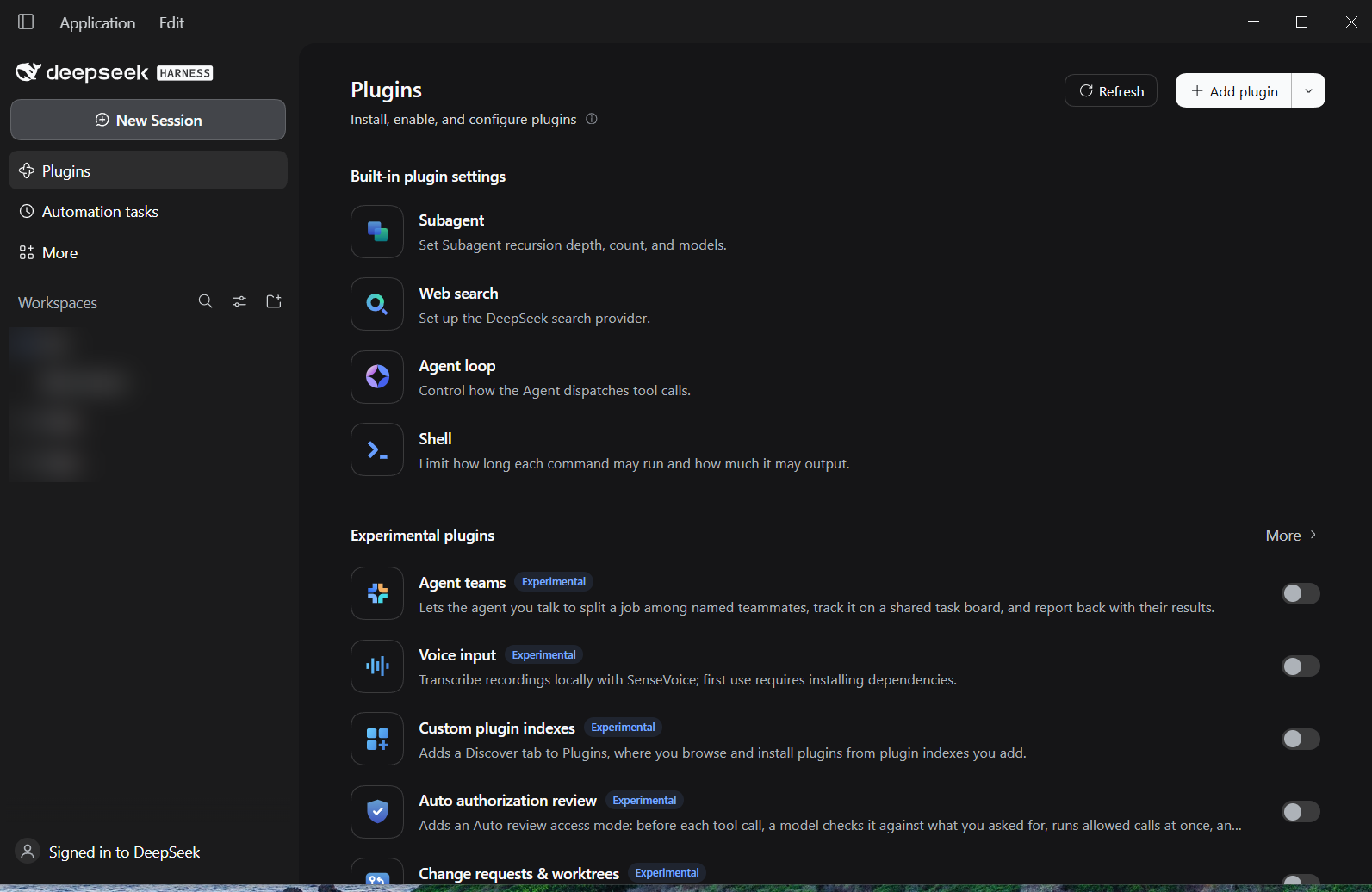
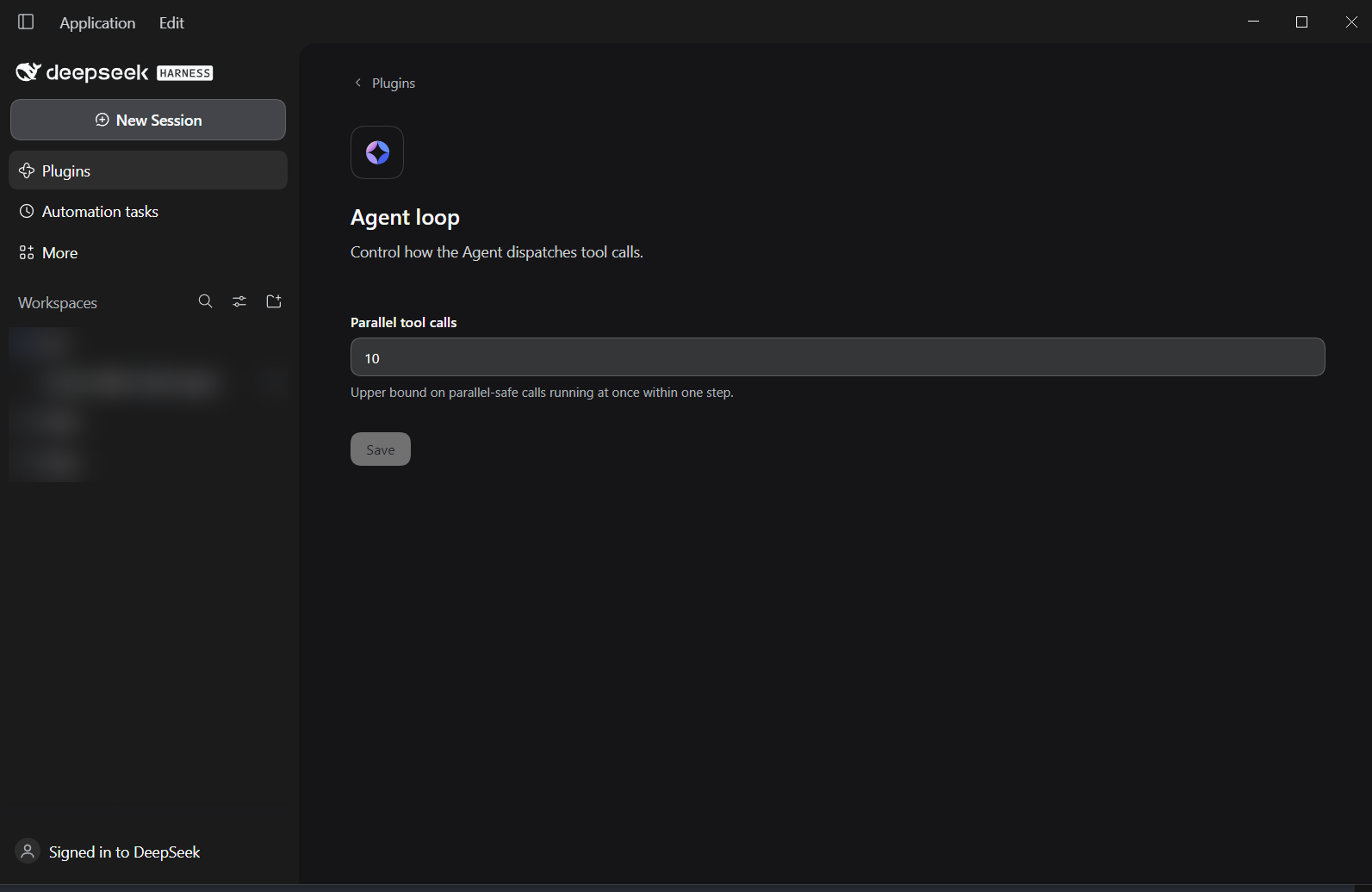
Opening Agent loop shows a single setting, parallel tool calls, set to 10. So the loop has its own settings page.
Creating a plugin with Creator mode
The Add plugin button has two paths: install a third-party plugin from npm, Git or a local directory, or let the agent create one in Creator mode.
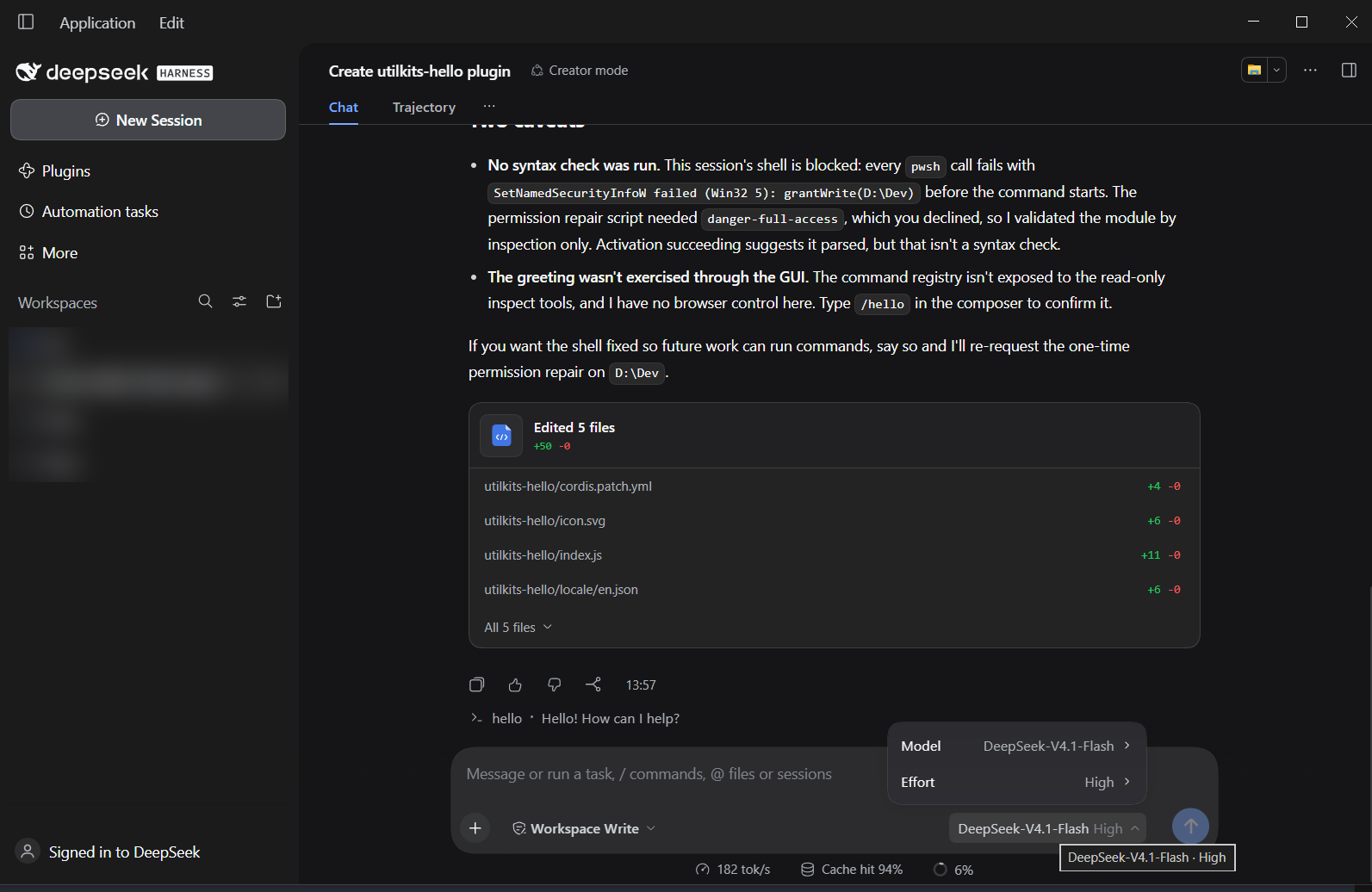
We used Creator mode with this prompt: create a minimal plugin named utilkits-hello with one slash command /hello that replies with a short greeting. The agent wrote five files totalling 50 lines. The logic fits in index.js:
export const inject = ['commands']

export function apply(ctx) {
  ctx.effect(() =>
    ctx.commands.register({
      name: 'hello',
      description: 'Replies with a short greeting.',
      handler: () => ({ kind: 'success', text: 'Hello! How can I help?' }),
    }),
  )
}
The rest is a package.json with a dsh.bundle.patch entry, a cordis.patch.yml that adds the plugin to the config, a locale file and an icon. After installation, /hello appeared in the command palette and printed its greeting.
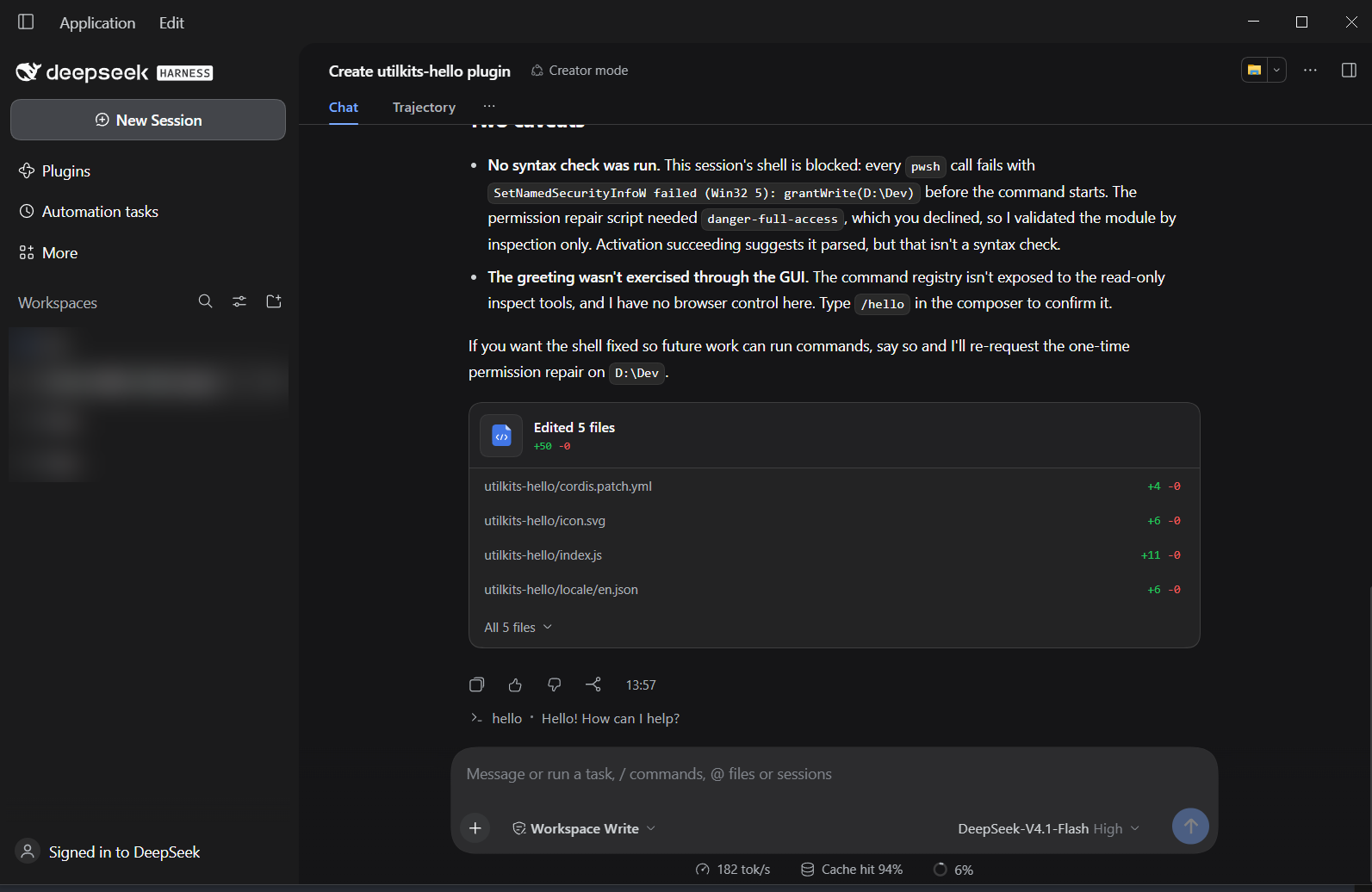
/hello command running after install.
Access mode and model settings
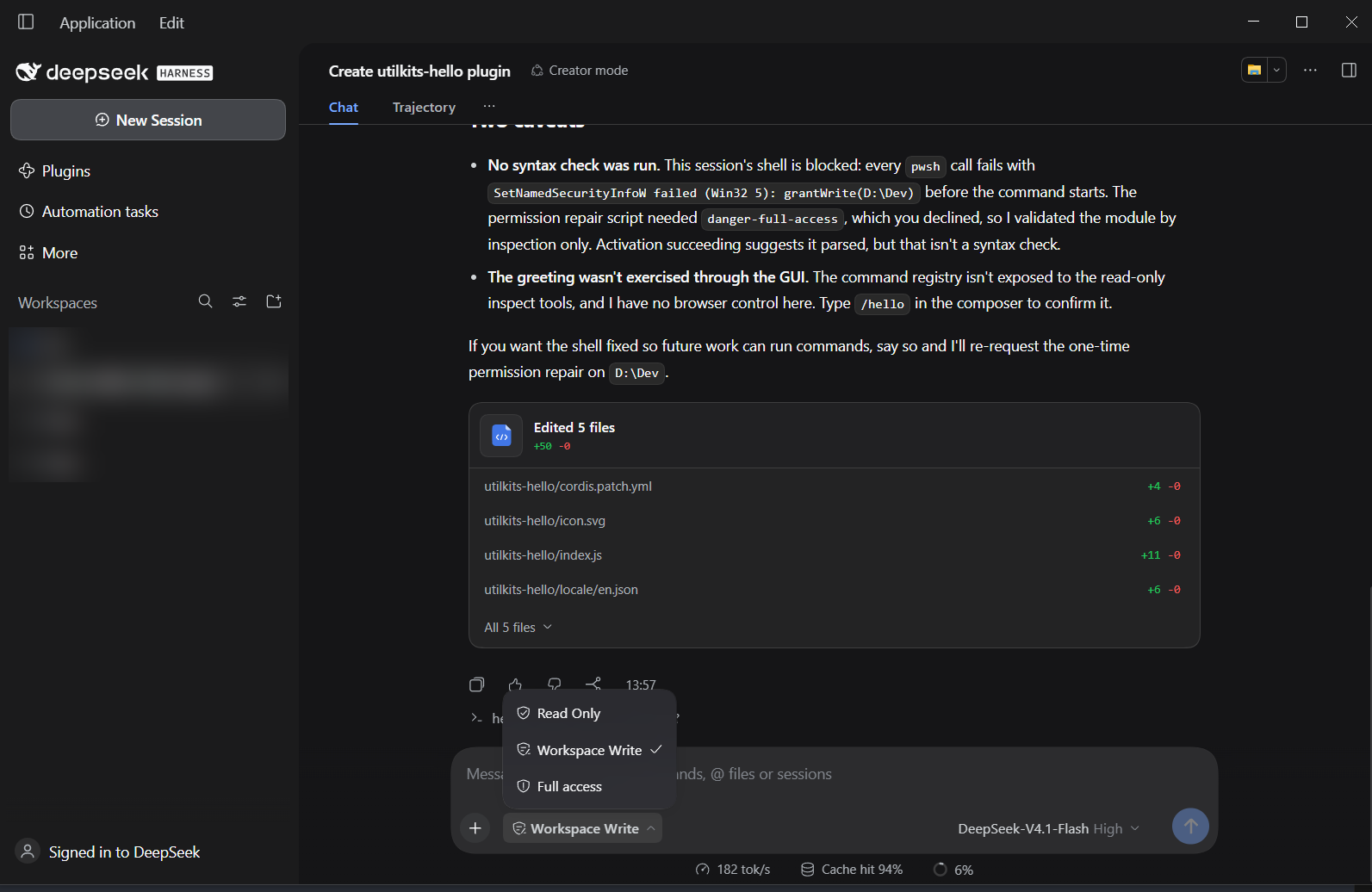
Access modes are Read Only, Workspace Write (default) and Full access.
The model picker has separate Model and Effort entries.
What do the benchmarks say?
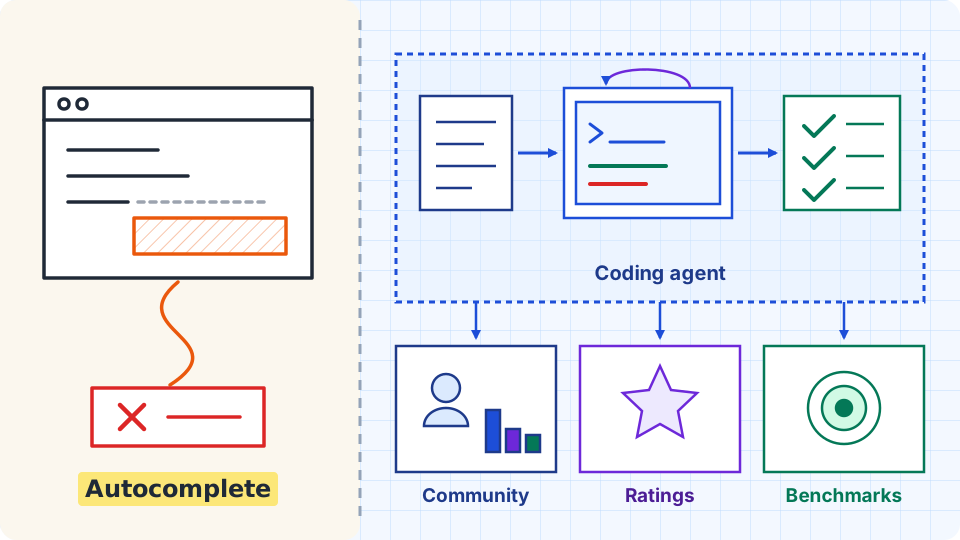
No benchmark isolates the harness cleanly. Composio, DataCamp and DeepSeek each measured a different slice.
Composio ran 30 hard tool-use tasks on real apps such as Gmail, Slack and GitHub, holding the model fixed at DeepSeek V4 Pro 0813:
| Harness | Tasks passed | Avg. tokens per task | Cost per shared success |
|---|---|---|---|
| Claude Code | 19/30 (63%) | 649,900 | $0.074 |
| DeepSeek Harness 0.1.0-rc.7 | 20/30 (67%) | 88,562 | $0.028 |
Pi passed 21, Codex 20, OpenCode 19 and Hermes 18 with the same model. A one-task difference is within noise. The token gap of about 7.3 times is larger, and Composio ties part of it to caching: in an earlier V4 Flash run, other harnesses paid 23% to 55% of the uncached price and Claude Code up to 99%. Claude Code does not officially support other vendors' models, so the test ran it outside its tuned setup.
In DataCamp's single-repo test with Claude Sonnet 5, both passed 10/10 tests with byte-identical patches. Claude Code took 55.0 seconds and dsh 125.4, partly because the Windows sandbox failure forced three manual full-access grants.
API prices also rose after launch. V4-Pro went from $0.435 input and $0.87 output per million tokens to $0.66 and $1.98 off-peak, or $1.32 and $3.96 at peak (VentureBeat), so the cost lead measured earlier may have narrowed.
DeepSeek Harness vs Claude Code vs Codex vs Antigravity
| DeepSeek Harness | Claude Code | Codex | Antigravity | |
|---|---|---|---|---|
| Maker and license | DeepSeek, MIT | Anthropic, closed | OpenAI, CLI under Apache-2.0 | Google, not fully open |
| Models | DeepSeek, Anthropic, OpenAI, local | Claude only | OpenAI by default | Gemini 3.x default, plus Claude and GPT-OSS |
| Design | Every part replaceable | One stronger agent | Agent inside clear execution boundaries | One shared harness for IDE, CLI and SDK |
| Maturity | Developer preview | Stable | Stable | Young, 2.0 announced May 2026 |
| Starting price | Free software, pay for model | Included in $20/month Pro | Included in $20/month Plus | Free, weekly limits |
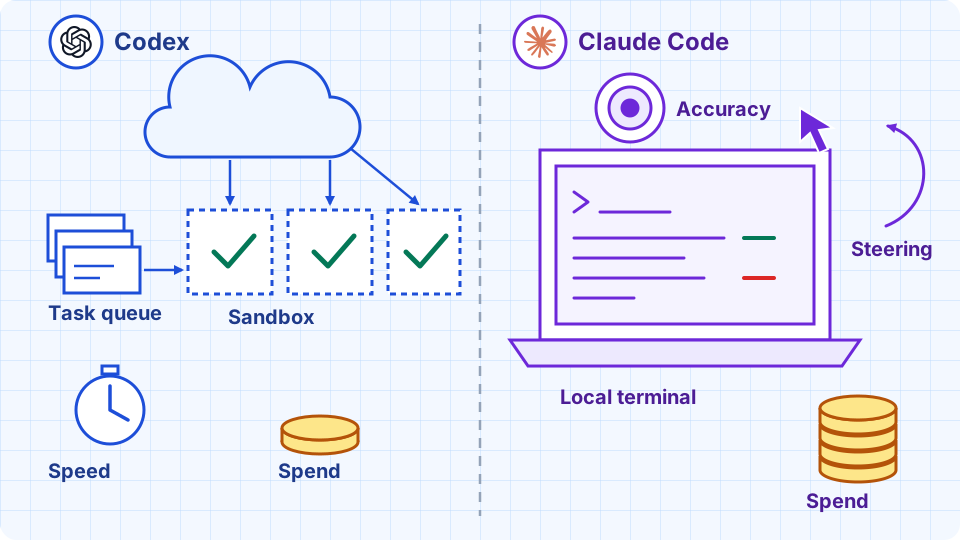
Compared with Claude Code, dsh offers more model choice, a replaceable loop and lower token use, but less polish. DataCamp recommends Claude Code for daily work in an existing codebase. For a direct head-to-head see Codex vs Claude Code.
Codex tied dsh at 20/30 in Composio's test. Codex adds cloud tasks and PR fixing, which dsh has not shown as finished, while Winder AI counts the tie to OpenAI models as its main weakness.
Antigravity is a different kind of product: an agent-first IDE in 1.0, five surfaces on one harness in 2.0, with a Go-based agy CLI since June 18, 2026. It runs several agents in parallel from a graphical Agent Manager. Its weak point is an undisclosed weekly quota, which the community reports slowing after about 2,000 generated lines. We found no head-to-head benchmark that includes it, so no ranking is possible. A wider ranking sits in top AI coding agents in 2026.
Which one should you choose?
- Modify the loop, compare providers or audit every step: DeepSeek Harness.
- Least configuration on an existing repo: Claude Code.
- Already on OpenAI, want an open-source CLI with cloud tasks: Codex.
- On Google infrastructure, want parallel agents in a visual UI or a free start: Antigravity.
Where this review can be wrong
The hands-on part is one session on Windows with the Flash model, building one tiny plugin. It covers the app and plugin system, nothing about dsh on real work. The benchmark numbers are secondary: Composio's 20 versus 19 is one task out of 30, run through its own MCP router, and Claude Code had two timeouts with no usage records. DeepSeek's own scores came from a minimal mode, with no SWE-bench result per VentureBeat. Antigravity has no benchmark at all, and star counts (95,386 after two days per Winder AI, 165,000 after a week per MindStudio) measure attention only. If the decision matters, run ten tasks on your own repo.
FAQ
Is DeepSeek Harness free? The software is free under MIT. You pay for model API usage, or run a local model.
Is it ready for production? Not yet. It is a developer preview, and DataCamp advises pinning the version before depending on it.
Sources
- VentureBeat, "DeepSeek Harness launches as open source rival to Claude Code, alongside V4-Pro on API with higher prices"
- The New Stack, "DeepSeek open sources an agent harness where everything is a plugin"
- Composio, "DeepSeek Harness vs Claude Code in 2026"
- DataCamp, "DeepSeek Harness vs. Claude Code: What Changes With the Same Model?"
- DataCamp, "What Is DeepSeek Harness? The Agent Runtime Where Everything Is a Plugin"
- Winder.AI, "A Comparison of AI Agent Harnesses in 2026"
- DEV Community, "DeepSeek Harness vs Codex vs Claude Code: What I Learned Comparing Three Agent Harnesses"
- Developers Digest, "Antigravity CLI vs Claude Code vs Codex 2026"
- DEV Community, "Google Antigravity 2.0: Gemini's agent-first desktop platform explained"
- Morph, "Google Antigravity vs Claude Code in 2026"
- MindStudio, "What Is DeepSeek Harness? The Open-Source Coding Agent Explained"