Top AI Coding Agents in 2026: Ranked by Community, Developer Ratings and Benchmarks
Which AI coding agent leads in November 2026? Claude Code, Codex, Cursor, GitHub Copilot and OpenCode ranked across community adoption, developer satisfaction and benchmark scores.
Quick answer: No single coding agent wins on every measure in November 2026. Claude Code is now the most-used agent at work (39%, 47% in the US), leads developer satisfaction (91% CSAT) and tops Terminal-Bench 4.0 (64.8%). GitHub Copilot remains the enterprise default at 21% workplace use with the widest awareness, while OpenAI's Codex grew fivefold to 16% at work and takes third on that benchmark (58.2%) at roughly one-eighth the run cost. Cursor slipped to 12% workplace adoption but still books a $4 billion revenue run-rate, and OpenCode leads open-source harnesses by GitHub stars.
Data vintage: JetBrains' AI Pulse survey was fielded in January 2026; its Developer Ecosystem Survey was fielded from May to July 2026. Stack Overflow fielded its survey from 23 June to 5 August 2026. The Pragmatic Engineer surveyed 906 subscribers from 27 January to 17 February 2026. Terminal-Bench 4.0 shipped on 28 August 2026, and SWE-Bench Pro V2 shipped on 22 September 2026. GitHub stars are a snapshot from 8 November 2026; npm downloads cover the 30 days to 6 November 2026.
What is an AI coding agent?
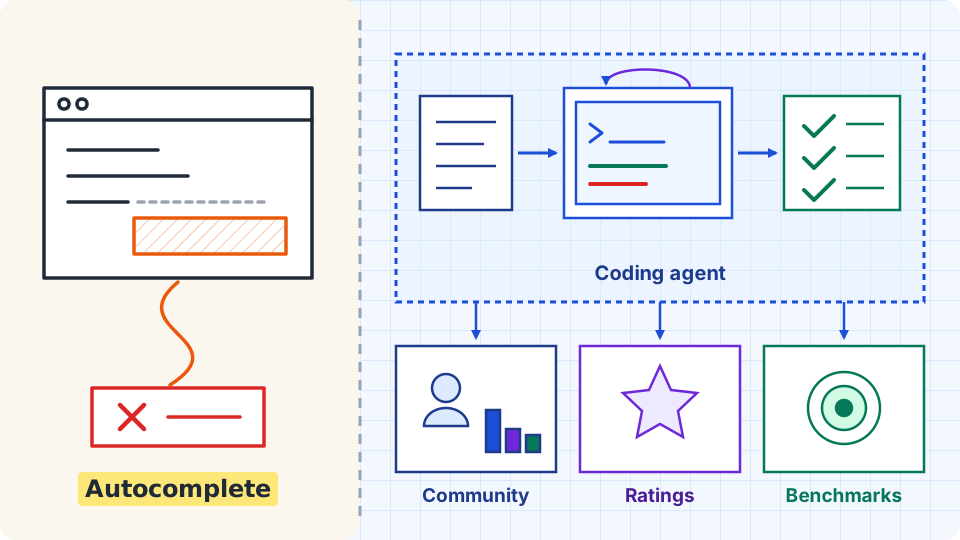
An AI coding agent takes a plain-language task, reads your repository, edits files, runs terminal commands and tests, and iterates until checks pass. Autocomplete suggests the next line, while an agentic engineering workflow finishes the ticket. In the Stack Overflow 2026 Developer Survey, 66% of AI users work with coding agents, nearly matching the 63% using chatbots. To run several of them in parallel, see the Orca Agent IDE review.
How this ranking works
Evaluating coding agents requires three lenses: community size, developer ratings, and benchmark scores. Because those lenses measure different things, combining them into one score blurs the comparison. Where comparable data is missing, the cell stays blank.
Lens 1: Which coding agents have the biggest communities?
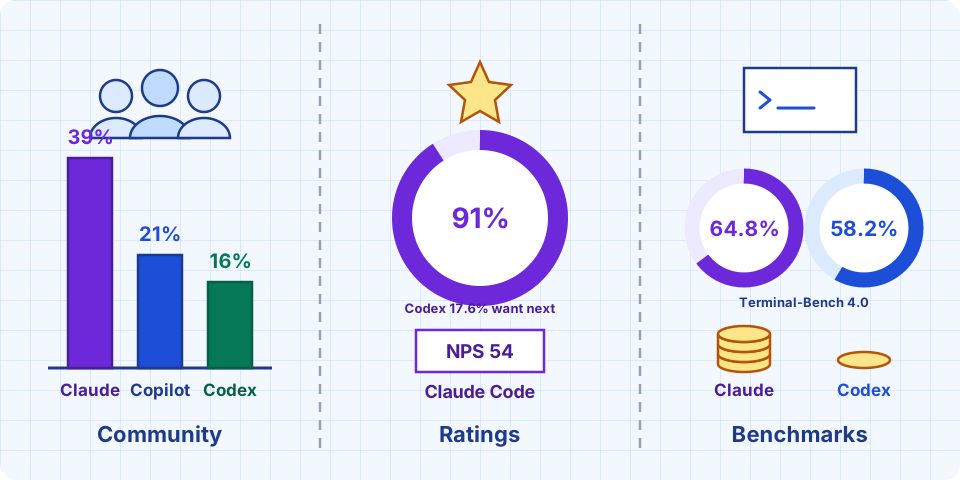
Workplace adoption surveys give a steadier signal than GitHub stars, which track bookmarking rather than daily usage. The most recent large workplace adoption sample is JetBrains' Developer Ecosystem Survey 2026, fielded from May to July 2026 and published in August: 90% used an AI coding agent at work at least weekly, and 68% used one daily. Workplace use came out at 39% for Claude Code (47% in the US), 21% for GitHub Copilot, 16% for OpenAI Codex, 12% for Cursor, 9% for JetBrains AI, 7% for OpenCode, and 6% for Google Antigravity. Claude Code was also the primary tool for 31% of developers, an almost 80% conversion rate from regular use.
The Stack Overflow 2026 Developer Survey, fielded from 23 June to 5 August 2026 and published on 6 October, measures tool selection among active coding-agent users: Claude Code (65.5%) and GitHub Copilot (58.7%) lead, followed by Codex (29.5%) and Cursor (25.5%); 73% of coding assistant or agent users run them daily.
Top 5 by community
- Claude Code. The clear leader at work: 39% worldwide, 47% in the US, and 65.5% among Stack Overflow's agent users. In its Series G announcement, Anthropic reported Claude Code's annualized run-rate revenue passed $2.5 billion in February 2026, up from $1 billion in November 2025.
- GitHub Copilot. It is still the enterprise default. Adoption was 40% at companies over 5,000 employees in the January 2026 wave, and awareness is 79% globally, but workplace use fell from 29% to 21% year over year.
- OpenAI Codex. Adoption rose fivefold from 3% in January 2026 to 16% in May to July, and awareness jumped from 27% to 65%. OpenAI reported over 5 million weekly active users on 2 June 2026, with ~20% in non-engineering roles (unaudited vendor figure). Its Apache 2.0 CLI (openai/codex) has 133,600 GitHub stars (snapshot 8 November 2026) and 95.6 million npm downloads in the 30 days to 6 November 2026, ahead of Claude Code's 47.4 million.
- Cursor. Workplace adoption slipped from 18% in January to 12% in May to July, and it sits fourth among Stack Overflow's agent users (25.5%). Press reports put annualized revenue at $2 billion in February and above $4 billion by June (~75% enterprise).
- OpenCode. The MIT-licensed open-source agent (sst/opencode) supports 75+ model providers and holds 225,200 GitHub stars (snapshot 8 November 2026), the highest among coding agent repositories. It reached 7% workplace adoption.
Honorable mentions: Gemini CLI (108,800 stars, Apache 2.0), Cline (71,400 stars), and Aider (50,000 stars), all snapshots from 8 November 2026. Note that anthropics/claude-code (154,900 stars) hosts docs and issue tracking rather than source code, so do not compare it star-for-star with OpenCode or Codex CLI.
Lens 2: Which coding agents do developers rate highest?
None of the public write-ups scores every agent on the same scale. JetBrains is the only large survey that publishes CSAT/NPS-style loyalty scores per tool, and its January 2026 AI Pulse data (published in April) gives Claude Code a 91% customer satisfaction score (CSAT) and a Net Promoter Score (NPS) of 54, which JetBrains described as the highest loyalty metrics on the market. The catch is that the write-up reports only Claude Code's scores. It gives no comparable CSAT/NPS figures for Copilot, Cursor or Codex, so read "highest" as JetBrains' summary, not a full scoreboard.
The other two measures are about preference, not satisfaction. In The Pragmatic Engineer's survey, fielded from 27 January to 17 February 2026 and published on 3 March, respondents named their most-loved tools: Claude Code 46%, Cursor 19%, GitHub Copilot 9%, OpenAI Codex about 8%, and OpenCode about 7%. The published text gives exact figures for the top three. The other two are read from the survey's chart. The Stack Overflow 2026 survey, fielded from 23 June to 5 August 2026, asks a different question: which agent they want to use in the next six months. There the order shifts: Claude Code 41.4%, GitHub Copilot 19.6%, OpenAI Codex 17.6%, then Cursor (11.7%) and OpenCode (11.7%). The Pragmatic Engineer sample is senior and terminal leaning. The median respondent has 11 to 15 years of experience, and 34% are in engineering leadership, so the survey measures enthusiasm among experienced engineers, not the average developer.
Top 5 by rating (ranked by "most loved")
- Claude Code. Leads both preference surveys (46% most loved, 41.4% want to use next) and is the only tool with public CSAT/NPS scores (91%/54).
- Cursor. Second in "most loved" at 19%, but only 11.7% want to use it next, the widest drop from affection to intent among the leaders.
- GitHub Copilot. Third in "most loved" at 9% but second in forward intent at 19.6%, which fits its large enterprise base.
- OpenAI Codex. About 8% named it their most-loved tool, and 17.6% want to use it next. That is close to Copilot on both measures, and third by forward intent.
- OpenCode. About 7% named it their most-loved tool, and 11.7% want to use it next. It is the open-source favorite.
At the model layer, the Stack Overflow 2026 Technology survey shows Anthropic and OpenAI tied in overall usage (75% vs 74%), while 49% of developers want to work with Anthropic next year versus 32% for OpenAI.
Lens 3: Which coding agents score highest on benchmarks?
Terminal-Bench 4.0, released on 28 August 2026, tests agents in real terminal containers with 66 tasks and a flat 8-hour timeout. SWE-Bench Pro V2, released on 22 September 2026, evaluates long-horizon multi-file tasks across 642 tasks in 11 repositories and re-grades every diff on a pristine image. SWE Atlas v1.1, updated in November 2026, covers codebase comprehension, test writing and refactoring across 284 tasks.
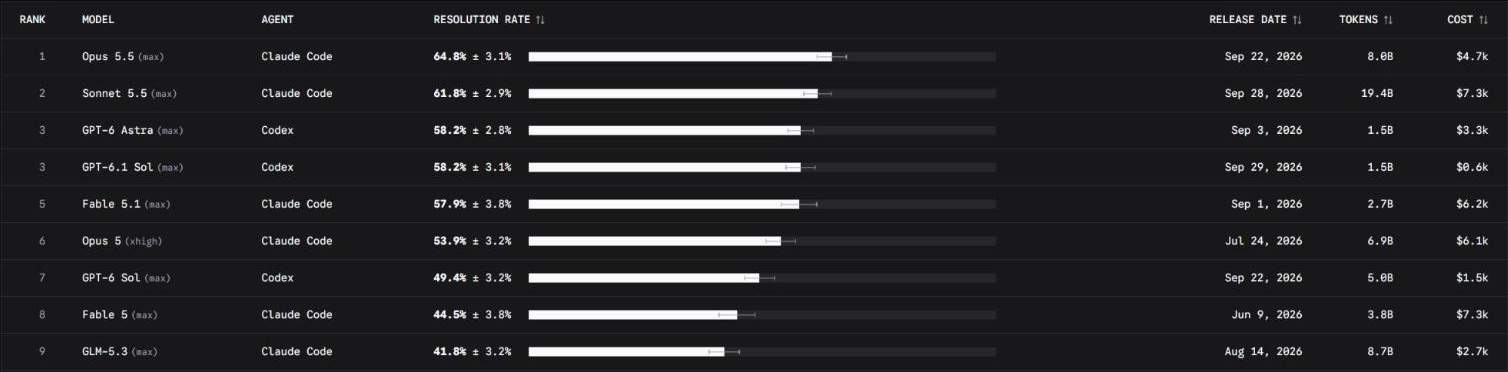
| Rank | Agent harness | Model (effort) | Resolution rate (95% CI) | Tokens | Run cost |
|---|---|---|---|---|---|
| 1 | Claude Code | Opus 5.5 (max) | 64.8% (±3.1%) | 8.0B | $4.7k |
| 2 | Claude Code | Sonnet 5.5 (max) | 61.8% (±2.9%) | 19.4B | $7.3k |
| 3 | Codex | GPT-6 Astra (max) | 58.2% (±2.8%) | 1.5B | $3.3k |
| 3 | Codex | GPT-6.1 Sol (max) | 58.2% (±3.1%) | 1.5B | $0.6k |
| 5 | Claude Code | Fable 5.1 (max) | 57.9% (±3.8%) | 2.7B | $6.2k |
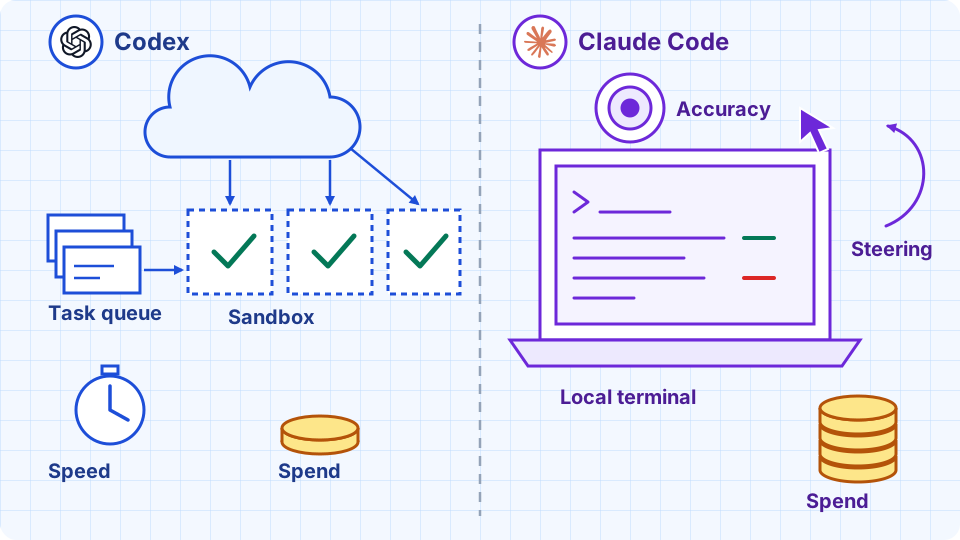
On Terminal-Bench 4.0, Claude Code with Opus 5.5 leads Codex with GPT-6.1 Sol by 6.6 percentage points. The Codex run cost roughly one-eighth as much ($0.6k vs $4.7k). Our Codex vs Claude Code comparison breaks down that trade-off. On the older Terminal-Bench 2.0 and 2.1 boards (2025 and early 2026), Codex CLI and third-party harnesses (NexAU-AHE, Capy) sat on top. Version updates reorder the table quickly.
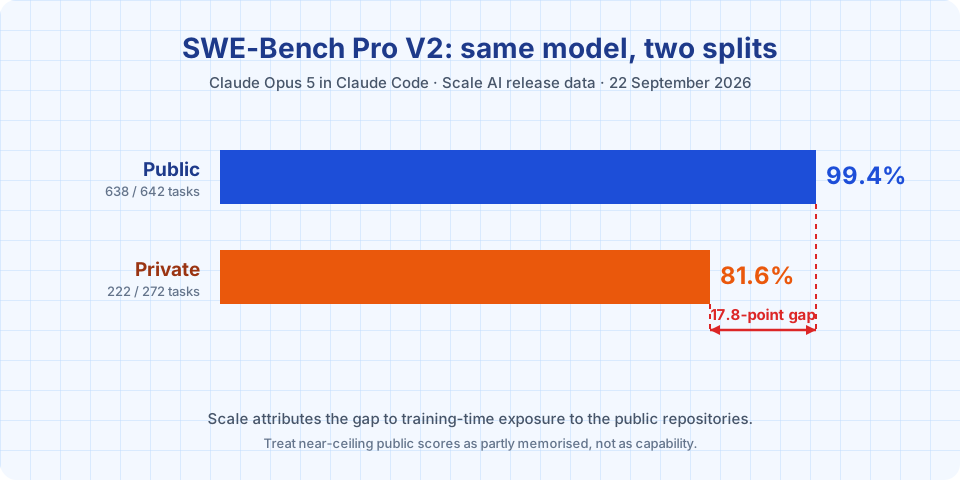
On SWE-Bench Pro V2, the public split is near ceiling. In Scale's release data, Claude Opus 5 resolved 638 of 642 public tasks (99.4%) but only 222 of 272 private tasks (81.6%). That is a 17.8-point gap, which Scale attributes to training-time exposure to the public repositories. Treat near-ceiling public scores as partly memorised rather than as a measure of capability.
Scale's V2 harness study tests the same idea. Reflection ran GLM-5.3, Kimi K3 and Inkling through mini-swe-agent, Pi and OpenCode on the same 642 tasks. Accuracy barely moved for Kimi K3 and GLM-5.3. What changed was token spend and time per task. Scale's takeaway: "Pick the harness for the bill, not the score."
The benchmark itself needed repair. OpenAI's July 2026 audit estimated that about 30% of SWE-Bench Pro's old public split was broken and retracted its recommendation to adopt it. V2 dropped 89 invalid tasks and re-verified the rest. BenchLM's 7 November 2026 update lists vendor self-reports where Claude Opus 5.5 reaches 89.9% and Sonnet 5.5 81.3%. These are model-level claims, not a standardized harness run.
On SWE Atlas v1.1, Opus 5.5 leads at 77.4%, ahead of Fable 5.1 (74.1%), Gemini 4 Argon (70.1%), GPT-6 Astra (69.4%) and GPT-6.1 Sol (65.9%).
Top by benchmark
- Claude Code. It takes first and second on Terminal-Bench 4.0 with Opus 5.5 and Sonnet 5.5, and Claude Opus 5 tops SWE-Bench Pro V2's public split. It also spends the most tokens.
- Codex. It is third on Terminal-Bench 4.0 with GPT-6.1 Sol. It reaches 90% of Claude Code's resolution rate at about 13% of the run cost. GPT-6 Astra is fourth on SWE Atlas v1.1 (69.4%).
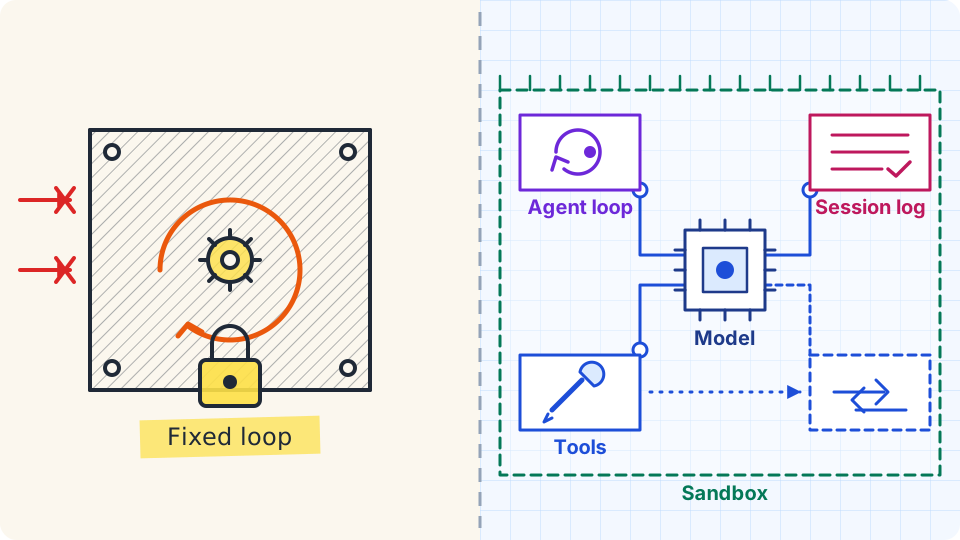
- Specialized harnesses. In V2's harness study, the loop changed cost and time more than accuracy for Kimi K3 and GLM-5.3. Pick the harness for the bill. For a harness where even the loop is a plugin, see the DeepSeek Harness hands-on review.
Side-by-side comparison
| Agent | Community | Rating | Terminal-Bench 4.0 | Paid entry price |
|---|---|---|---|---|
| Claude Code | 39% work (#1); 65.5% SO choice | CSAT 91%, NPS 54 (#1); 46% loved | 64.8% (Opus 5.5, #1) | $20/mo (Claude Pro) |
| Codex | 16% work; 29.5% SO; 5M+ WAU; 95.6M npm/mo | ≈8% loved; 17.6% want | 58.2% (GPT-6.1 Sol, #3) | $20/mo (ChatGPT Plus) |
| Cursor | 12% work; 25.5% SO; $4B+ ARR | #2 loved (19%); 11.7% want | Model-dependent | $8/mo Plus, $30/mo Premium (Cursor) |
| GitHub Copilot | 21% work; 58.7% SO; 79% awareness | #3 loved (9%); 19.6% want | Model-dependent | Free tier; $10/mo Pro (GitHub) |
| OpenCode | 7% work; 225.2K stars (#1 OSS) | ≈7% loved; 11.7% want | Model-dependent | Free MIT CLI; API tokens |
Loved = share naming it their most-loved tool (The Pragmatic Engineer, January to February 2026). Want = share who want to use it in the next six months (Stack Overflow, June to August 2026).
Overall ranking and where this data is weak
After weighting developer ratings and benchmark results above install base, the order is Claude Code, Codex, Cursor, GitHub Copilot, OpenCode. Adoption reflects procurement and habit. Satisfaction and container benchmarks show what holds up on multi-file tickets today.
Even so, this ranking has blind spots. The community lens mixes two different questions. One is workplace adoption across all professional developers (JetBrains); the other is tool choice among people who already use agents (Stack Overflow). The percentages are not directly comparable. The May to July 2026 JetBrains wave is the most recent representative sample, but the market moves quarterly: Cursor's slide and Codex's climb could reverse. Satisfaction numbers skew toward self-selected terminal users, who rate their chosen tools generously. Benchmark scores also reflect max effort settings that burn more tokens than default daily runs. Scale alone now publishes SWE-Bench Pro V2, SWE Atlas, MCP Atlas, HiL-Bench, RLI and DrugDiscoveryBench. Each measures a different slice of agent work, and no single board should decide a purchase.
None of these leaderboards prove an agent makes your team faster. In METR's July 2025 randomized trial, 16 experienced open-source maintainers took 19% longer with AI tools despite believing they were 20% faster. METR's February 2026 follow-up hit selection bias because developers refused the no-AI control group. Pair any agent with spec-driven development tools and run a two-week bake-off on ten real tickets in your repo before standardizing.
FAQ
What is the best AI coding agent in 2026? Claude Code leads on workplace adoption (39%), satisfaction (91% CSAT) and Terminal-Bench 4.0 accuracy (64.8%), and Claude Opus 5 tops SWE-Bench Pro V2's public split. Codex is the top lower-cost benchmark contender ($0.6k vs $4.7k run cost), and GitHub Copilot remains the enterprise default (21% workplace use, 79% awareness).
Is Claude Code better than Codex? On Terminal-Bench 4.0, Claude Code with Opus 5.5 beats Codex with GPT-6.1 Sol by 6.6 points (64.8% vs 58.2%), while Codex costs roughly one-eighth as much and ships an Apache 2.0 CLI.
Is there a free AI coding agent? OpenCode, Codex CLI, Cline, Gemini CLI, and Aider are open-source tools where you pay only for API calls or local models. GitHub Copilot and Cursor also offer free tiers.
Do AI coding agents make developers faster? Surveys say yes, while controlled trials remain mixed. METR's 2025 trial found experienced maintainers were 19% slower with AI, and its 2026 update could not re-measure the gap because developers refused to work without AI.
Sources
- Terminal-Bench 4.0 Leaderboard and release notes (28 August 2026)
- Scale AI SWE-Bench Pro V2 Leaderboard and release post (22 September 2026)
- Scale AI SWE Atlas v1.1 (November 2026)
- JetBrains Research: AI Coding Tools at Work (April 2026) and AI Coding Agents: Adoption Trends (August 2026)
- Stack Overflow 2026 Survey (6 October 2026), AI Data, and Methodology
- The Pragmatic Engineer: AI Tooling 2026 (3 March 2026)
- Anthropic Series G and Claude Pricing
- OpenAI: Codex for Knowledge Work, API Pricing, and July 2026 evaluation audit
- GitHub: sst/opencode, openai/codex, anthropics/claude-code, google-gemini/gemini-cli, cline/cline, Aider-AI/aider
- TechCrunch: Cursor $2B ARR, Dealroom: Cursor $4B ARR, Cursor Pricing, Copilot Plans
- METR: 2025 AI Developer Study and 2026 Uplift Update
- BenchLM: SWE-bench Pro (7 November 2026)