
Claude Down on 13 November 2026: When Work Built Around One AI Stops
Claude went down twice on 13 November 2026, a day after Microsoft 365 failed. What the outages say about work and companies that depend on a single AI service.
Claude went down twice on 13 November 2026, a day after a Microsoft 365 outage took out mail, Teams and Copilot for many people. Sign-in to claude.ai and Claude Code failed for two hours, and errors across claude.ai, the API and Claude Code followed in the afternoon. For anyone whose daily routine runs through one AI assistant, work stopped while it happened, and the episode raises an uncomfortable question about how much of that routine still works without the tool.
Two outages in one day
The Claude status page logged both. The first incident, 09:58 to 11:58 UTC, was an authentication failure on claude.ai and Claude Code. The second, 13:09 to 15:38 UTC, hit claude.ai, the Claude API and Claude Code, then spread to connectors, Managed Agents and Claude Security. Added up from the timestamps, that is 4 hours 29 minutes. Anthropic's incident pages give no root cause as of 14 November. Microsoft 365 had its own outage the day before (advisory MO1550821), a separate incident that landed in the same stretch of days (BleepingComputer).
Neither outage is unusual for a cloud service. The more interesting part is what each one reveals about the people and systems built on top of it.

Would work stop without Claude?
The question worth asking is whether work would stop completely without Claude. For a person whose drafting, reviewing, searching and planning all pass through one assistant, a two-hour sign-in failure answers it: yes, at least for that stretch. The longer answer is less comfortable, because a stopped tool and a stopped person are different things. What stops is a routine built around one tool. How much of that work could be done at the same speed without it is unknown until someone tests it, and this piece did not run that test. My own guess is that for heavy users the honest answer is "less than they think", because the habit of reaching for the tool hides how much it carries.
What can be described is the mechanism, as a reflection and not a measurement. When one assistant sits in the middle of several steps, a single failure removes all of them at once. Dependency like that rarely arrives in one decision. Each step handed to the tool looks reasonable on its own, and an outage is the first time the sum becomes visible. The risk is the lack of a second route, since nothing else is ready to take over.
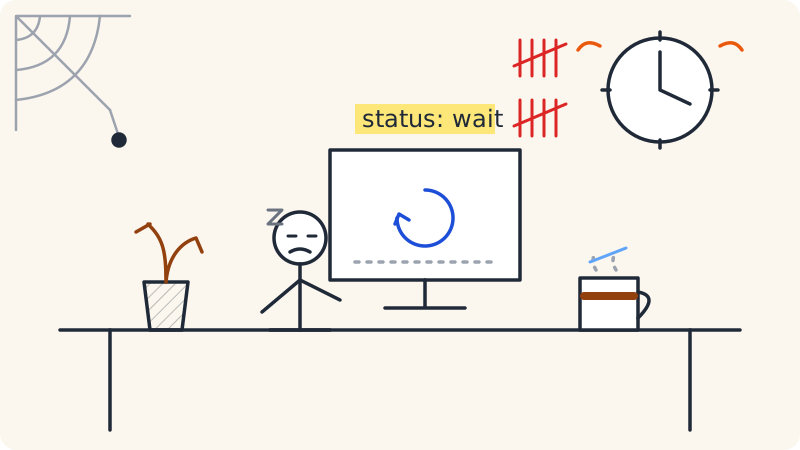
Waiting on the status page while the spinner keeps turning. Original drawing.
What companies with AI in their systems face
The two incidents hit different layers. In the morning, sign-in failed on claude.ai, Claude Code and the Console, which locks out the people using them. In the afternoon, the API, Managed Agents and scheduled routines returned errors, which breaks whatever runs without anyone watching. A company usually depends on both, and each needs its own fallback.
The people layer carries the quieter risk. When a team has Claude do steps A, B and C of a task, the fallback on paper is to do them by hand. After months of handing the work over, people forget how the manual version goes, or they remember and do not want to do it, because the habit of delegating to AI has set in. In my view, this matters more than a missing second provider, since it wears away unnoticed and no status page shows it. A manual fallback nobody has run in months is a guess about how long the work takes.
Skipped runs leave no trace. At 15:33 UTC the status page said scheduled tasks and routines could run more than two hours late and some runs were skipped, and Claude Security scans, reviews and project setup were delayed. A skipped run sends no request, so a dashboard of error rates shows nothing. That is an inference, not something the feed states, and the fix it points to is a check that each important job's expected result actually arrived. Personally, I think the skipped runs were the more serious part of that afternoon than the errors, since an error gets noticed and a silent skip does not.
Check Claude status before guessing
When Claude stops responding, the first thing to know is whether the fault is local or on the provider's side. The official Claude status page has a JSON endpoint and an Atom feed. Both were queried from Git Bash on Windows on 14 November 2026:
curl -s https://status.claude.com/api/v2/status.json
curl -s https://status.claude.com/history.atom | grep -o '<title>[^<]*</title>' | sed -n '2,5p'
The first returned "indicator":"minor","description":"Partially Degraded Service", from a purchasing-errors incident that day. The second listed recent incident titles, newest first. Subscribe to the page for alerts and check the component in use, because claude.ai, the API and Claude Code can fail separately.
Have a second route before the next outage
The outages are not a reason to drop Claude, and they are not a reason to shrug. They show how much of a routine can hang on one point of failure. The first fix is a second agent that is already signed in, and the Codex vs Claude Code comparison and the ranking of coding agents help with that choice. In my opinion it is the cheapest fix and should come before anything else. A small local model, set up as in the Ollama vs LM Studio guide, could cover drafts and reformatting, though I think of a local model as a convenience and not a substitute for a frontier model. Teams can put a fallback behind a gateway, as the 9Router guide describes. No failover was tested here, so all of this is reasoning from one day of incidents.
Satya Nadella's advice to assume the model is compromised was about security. Assuming the dependency will fail applies the same habit to availability, and a status page is a cheaper place to learn that than a missed deadline.
Sources
- Claude Status, incident history and its Atom feed, read 14 November 2026.
- Elevated errors on claude.ai, Claude Code, and platform.claude.com - Anthropic status, 13 November 2026.
- Elevated errors on claude.ai, the Claude API, and Claude Code - Anthropic status, 13 November 2026.
- Massive Microsoft 365 outage disrupts Outlook, Teams, Copilot worldwide - BleepingComputer, 12 to 13 November 2026.