Gemini 4 Models Reviewed: Which One to Pick and How Neon Beats 3.8 Flash
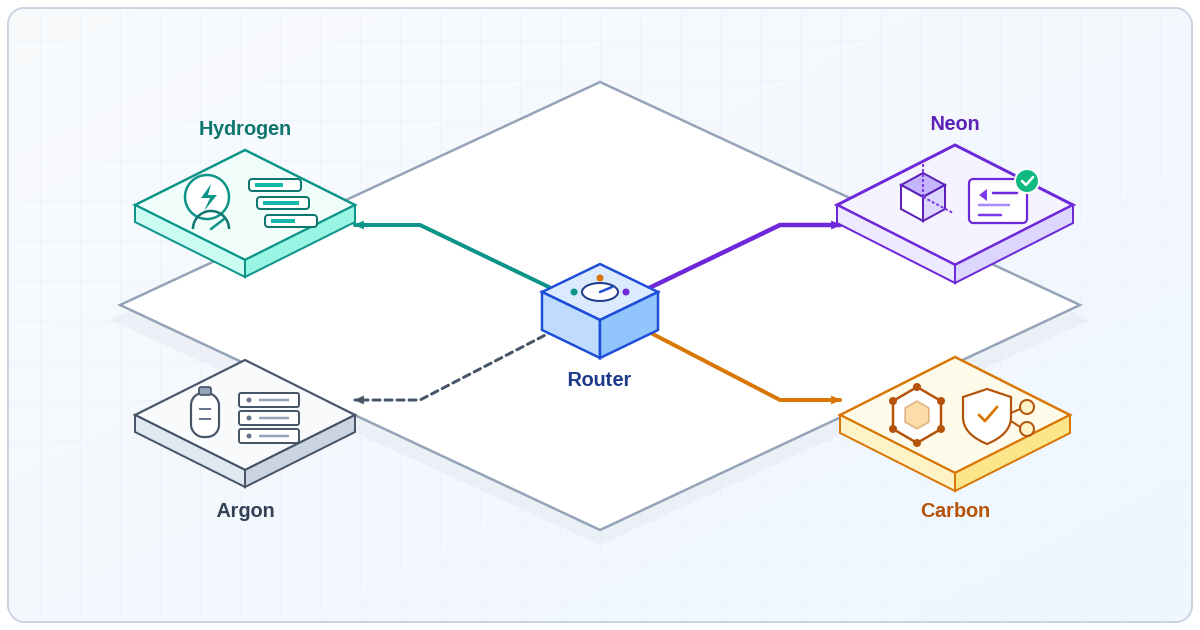
Google split Gemini 4 into four element tiers: Argon, Carbon, Hydrogen, and Neon. Here is where each fits, why Argon is squeezed, and how Neon beats 3.8 Flash on a 3D animation test.
Start with Gemini 4 Neon as your default for complex coding and spatial or visual tasks. Route fast routine edits and parallel worker agents to Gemini 4 Hydrogen, and save Gemini 4 Carbon for hard architectural, scientific, or security problems where slower turns pay off. Gemini 3.8 Flash only makes sense while its $0.75/$3.75 introductory price runs through December 31, 2026. Skip Gemini 4 Argon on new projects, because Carbon matches its price and Neon beats it on speed and coding benchmarks.
Between September 30 and November 18, 2026, Google replaced its Flash-and-Pro naming pattern with four chemical elements under the Gemini 4 banner. Each model targets a specific point on the curve between response speed, reasoning depth, and cost per completed task.
How Do the Four Gemini 4 Models Compare?
Across the Gemini 4 lineup, Google pairs a 1 million-token context window (the maximum input a model can read in one request) with native multimodal understanding over documents, charts, and video; Hydrogen and Neon also explicitly list audio.
| Model | Release Date | API Price (per 1M in / out) | Best Fit |
|---|---|---|---|
| Gemini 3.8 Flash | Sep 2, 2026 | $0.75 / $3.75 intro ($1.50 / $7.50 from Jan 1, 2027) | Budget pipelines until year-end |
| Gemini 4 Argon | Sep 30, 2026 | $2.00 / $10.00 intro ($4.00 / $20.00 standard) | Existing early-adopter pipelines |
| Gemini 4 Carbon | Nov 10, 2026 | $2.00 / $10.00 until Nov 30, 2026 ($4.00 / $20.00 after) | Deep architecture, audits, science |
| Gemini 4 Hydrogen | Nov 12, 2026 | $1.50 / $7.50 flat | Fast daily work, parallel workers |
| Gemini 4 Neon | Nov 18, 2026 | $3.00 / $15.00 ($0.15 cached input) | Daily driver for complex engineering |
Carbon's $2/$10 introductory rate expires on November 30, 2026, moving it to $4/$20, above Neon's $3/$15. Meanwhile, Gemini 3.8 Flash jumps to $1.50/$7.50 on January 1, 2027, matching Gemini 4 Hydrogen dollar for dollar.
What Does Each Gemini 4 Model Do Best?
Gemini 4 Neon: The Daily Driver for Hard Work
Neon is the clearest all-around pick in the lineup. Shipped on November 18, 2026, it sits between Hydrogen and Carbon, pairing frontier-grade reasoning with fast end-to-end completion. On the Artificial Analysis Coding Agent Index, Neon ranks #1 overall at 58.6, and at its highest (xhigh) thinking setting it reaches 61 on the Artificial Analysis Intelligence Index. At its default high setting, it runs at 32% lower cost per task than Carbon.
Neon works as a daily driver because it stays disciplined. It ranks #2 on steerability (adapting when you correct it mid-task), hits a 99.2% pass rate on Google's agent honesty evaluation, and recorded the lowest fabrication rate in internal testing inside Google Antigravity (Google's agentic development platform). In my view, Neon is the model most developers should wire in first, because it finishes multi-file debugging, spatial UI work, and dense document synthesis without making you wait through Carbon's long thinking loops.
Gemini 4 Hydrogen: Fast Execution and Parallel Workers
Hydrogen brings Gemini 4 down to $1.50 input and $7.50 output per million tokens (flat across its 1 million-token context window, with up to 1 million output tokens). Launched on November 12, 2026, it edges past Argon on the Artificial Analysis Intelligence Index even at its default high thinking level (51 vs 50) and scales across four thinking levels (low, medium, high, and xhigh).
Hydrogen works best when you split a big job into small, concrete edits. It natively batches parallel file reads and searches, handles live UI prototyping well, and is the fast worker tier in multi-agent setups. Its limit is open-ended architectural judgment on messy, ambiguous codebases, where extra thinking depth from Neon or Carbon pays off.
Gemini 4 Carbon: Maximum Depth for Architecture and Research
Carbon is Google's heaviest reasoning model, generally available since November 10, 2026. It spends extra thinking tokens exploring hypotheses and running extended verification loops. Google's engineering teams used it for overnight multi-agent 3D reconstructions, formal mathematical verification of Signal's cryptographic protocol in Lean (a proof-checking language), and finding zero-day vulnerabilities in public digital infrastructure.
Carbon is overkill for routine feature tickets or quick UI tweaks. The $4/$20 standard price and slower turnaround make sense on tasks where a wrong design decision costs days: cross-subsystem root-cause investigations, security audits, large-scale migrations, and scientific data analysis. On Google's 375-task agentic honesty benchmark, Carbon passed 92% of tasks (up from 70% on Argon), declining to invent missing experimental data 98% of the time.
Gemini 4 Argon: The Early Flagship Now Squeezed in the Middle
Argon was the first Gemini 4 release on September 30, 2026, and it introduced the 1 million output-token ceiling (up from the previous 64K cap). Google used it internally to migrate C and C++ libraries like libgav1 (a video decoder) to safe Rust and free over 300 TiB (tebibytes) of data-center memory. It also set early marks on the DeepSWE v1.1 software engineering benchmark (77.9%) and long video understanding on LVBench (91.7%).
Six weeks later, Argon sits in an awkward spot. Carbon costs the same ($2/$10 intro, $4/$20 standard) with stronger reasoning, better alignment, and 0% indirect prompt-injection success on Gray Swan's benchmark. Hydrogen matches or beats Argon on the Artificial Analysis Intelligence Index for less money, while Neon beats it on coding benchmarks and ranks #2 overall on steerability. Unless you already tuned an enterprise pipeline around Argon, there is little reason to pick it today.
Why Upgrade From Gemini 3.8 Flash?
In our September 2026 frontier AI model comparison, Gemini 3.8 Flash stood out as a strong budget coding model at $0.75/$3.75. Its design relied on extra reasoning steps and iterative tool calls, which sometimes inflated token usage on tricky tasks.
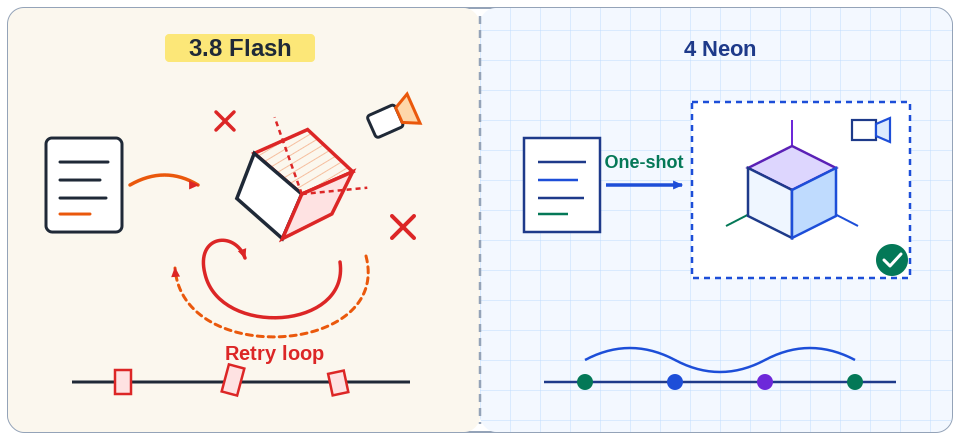
The gap between 3.8 Flash and Gemini 4 shows up fast once a task demands spatial reasoning and strict script adherence. When I tested building an animation that combined 3D elements from a script, Gemini 3.8 Flash repeatedly got the camera perspective wrong. Even after multiple correction prompts, the output barely improved. Running the same type of 3D animation script on Gemini 4 Neon produced a result that matched the script in one shot. I ran that check informally on my own 3D animation script and did not run a formal multi-prompt benchmark across all five models.
That hands-on gap lines up with Google's published numbers. Compared with 3.8 Flash, even the lighter Gemini 4 Hydrogen finishes tasks 2.5x faster at its default high setting, cuts fabricated claims by more than 5x, and runs 2x to 2.8x faster with 12% to 23% fewer tokens on data-heavy enterprise SQL and graph workflows. On defensive security, Gemini 3.8 Flash Cyber hit 47.2% pass@1 (first-attempt fix rate) on Collinear's CWE-bench security patching benchmark, while Gemini 4 Neon for cyber reaches 70.7% (+3.4% over Carbon).
Once 3.8 Flash's introductory price expires on December 31, 2026, its standard $1.50/$7.50 rate costs the same as Hydrogen. At that point, you pay the same token rate for a slower model that drifts more often on complex instructions. Clearer specifications help any model, as covered in our modern prompt engineering guide, yet a model that holds spatial geometry on the first pass saves far more time than prompt tuning alone.
How to Pair Them in Real Workflows
Google designed the Gemini 4 models to work together inside an agent harness (the orchestration layer that manages prompts, tool calls, and verification), splitting planning, execution, and auditing across tiers.
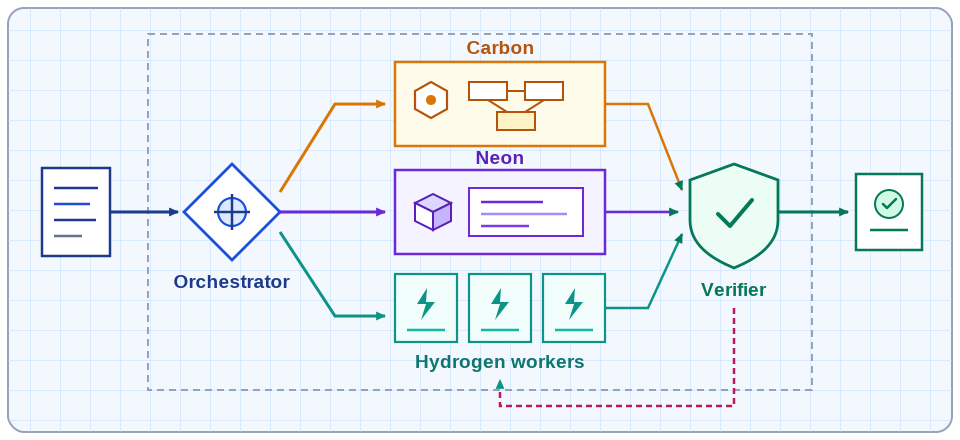
In Google Antigravity, the new Orchestrator switches dynamically between Carbon and Hydrogen within the same session, reaching near-Carbon task success rates while consuming 24% less quota and finishing 19% faster. With /swarm (Antigravity's parallel multi-agent mode), teams assign Carbon or Neon to plan architecture and audit diffs while parallel Hydrogen workers edit files and run tests in isolated workspaces. Running inside the full Google Antigravity harness also lifts standalone Neon sharply, pushing its score on SWE-sweep (a multi-file bug-fixing benchmark) from 12.8% on a minimal harness to 39.0%.
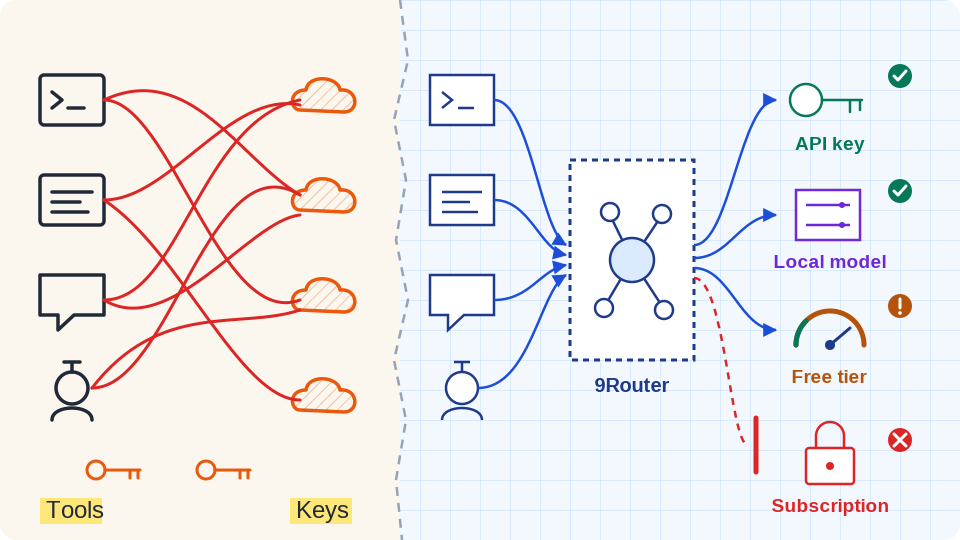
If you run multiple providers across top AI coding agents or route API traffic through a local proxy like 9Router, the practical setup is straightforward: set Neon as your default coding model, route high-volume subagents and routine edits to Hydrogen, and escalate to Carbon only for architectural design, formal checks, or tough root-cause bugs.
This release feels solid to me because I use Google Antigravity in my daily work, and Gemini 4 has upgraded several parts of my workflow.
Sources
- Introducing Gemini 3.8 Flash and 3.8 Flash Cyber - Google Blog (Sep 2, 2026): specs, benchmarks, Cyber results, and introductory pricing expiry.
- Introducing Gemini 4 Argon - Google Blog (Sep 30, 2026): 1M output limit, DeepSWE v1.1, LVBench, internal migrations, and pricing.
- Gemini 4 Carbon is now available - Google Blog (Nov 10, 2026):
/swarm, scientific reasoning, safety benchmarks, and November 30 intro pricing deadline. - Introducing Gemini 4 Hydrogen for Agentic Workflows - Google Blog (Nov 12, 2026): $1.50/$7.50 flat pricing, Antigravity Orchestrator metrics, and 3.8 Flash comparisons.
- Introducing Gemini 4 Neon - Google Blog (Nov 18, 2026): $3/$15 pricing, Artificial Analysis Coding Agent Index, steerability, and cyber benchmarks.